Nifty Plunges: Why Indian Markets Saw Red Today
Key Takeaways:
- **Benchmark Indices Decline:** Nifty traded below the 24,100 mark, while Sensex also saw significant losses, indicating broad market weakness.
- **HDFC Bank Defies Trend:** HDFC Bank emerged as a rare gainer, rising approximately 2% amidst the broader market downturn.
- **Sectoral Pressure:** Metal, IT, and PSU bank stocks were among the biggest laggards, contributing heavily to the market's negative sentiment.
- **Investor Caution:** The sell-off signals increased caution among investors, with focus shifting to underlying economic indicators and corporate earnings.
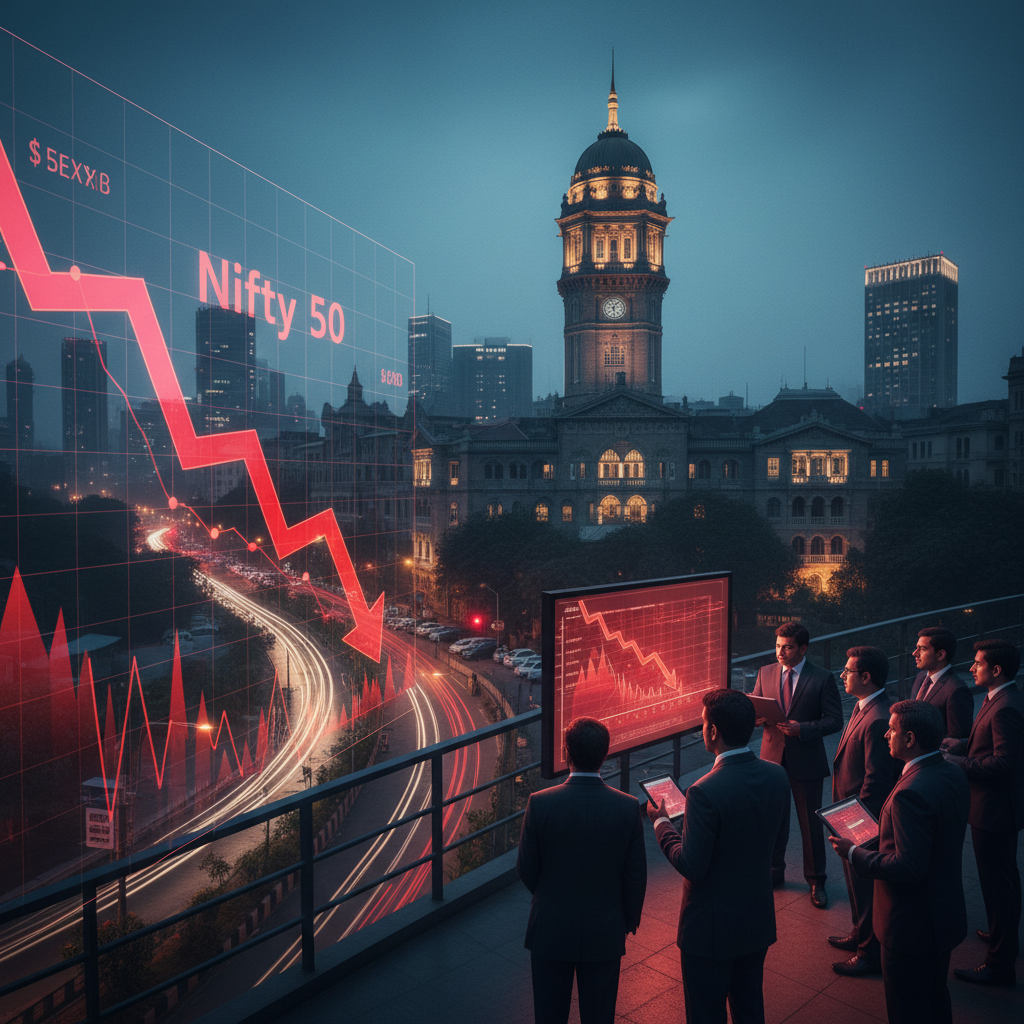
Indian equity markets experienced a significant downturn today, August 31, 2026, as both the Nifty 50 and BSE Sensex succumbed to selling pressure. The benchmark Nifty index dipped below the crucial 24,100 level, while the Sensex shed hundreds of points, leaving investors questioning the sudden shift in market sentiment. This broad-based weakness has ignited discussions across financial circles, with many seeking to understand the catalysts behind today's market performance.
Why Did Indian Markets Fall Today?
The market decline on August 31, 2026, was driven by a confluence of factors, leading to widespread profit-booking and a noticeable shift in investor sentiment. While specific triggers are always complex, several key themes emerged throughout the trading session. The overall mood was one of caution, as global cues and domestic concerns weighed heavily on investor decisions. Many market participants are now closely watching for signs of stabilization or further volatility in the coming days.
One of the primary reasons for the market's southward trajectory was the broad-based selling seen across various sectors. This was not an isolated event affecting just a few stocks but rather a systemic correction that impacted a significant portion of the market. The selling pressure intensified as the day progressed, pushing key indices into the red.
Which Sectors Dragged the Market Down?
Today's market weakness was particularly pronounced in specific sectors, acting as major drags on the overall indices. Among the hardest hit were the metal, information technology (IT), and public sector undertaking (PSU) bank sectors. These segments witnessed substantial selling activity, contributing significantly to the benchmark indices' decline.
- **Metal Stocks:** The metal sector faced considerable headwinds, with several prominent metal companies seeing their share prices fall. This could be attributed to concerns over global demand or commodity price fluctuations, leading investors to offload their holdings.
- **IT Stocks:** The technology sector, often a bellwether for market sentiment, also experienced significant pressure. Major IT names, including Infosys and Tata Steel, were cited among the early losers, indicating a broader cautious outlook towards the tech space.
- **PSU Bank Stocks:** Public sector banks also found themselves under pressure, with investors pulling back from these institutions. This could be linked to broader concerns about asset quality, lending growth, or government policies affecting the banking sector.
These sectoral pressures highlight a shift in investor preference, possibly towards more defensive plays or away from sectors perceived as having higher risk exposure in the current environment. For a deeper dive into sector-specific trends, explore our Sector Analysis.
What TradeMine AI Says
TradeMine AI's advanced Smart Money Concepts engine has been tracking the shifting market dynamics closely. Our analysis indicates that today's sell-off, while significant, shows signs of being influenced by profit-booking at higher levels rather than a fundamental change in long-term bullish trends for specific high-quality stocks. The AI noted increased institutional distribution in select overvalued segments, aligning with the observed sectoral weakness.
- **Nifty Support Zones:** TradeMine AI identified a critical support zone for Nifty around the 23,980-24,020 range. A sustained breach below this level could signal further downside momentum, whereas a bounce back could indicate consolidation.
- **Potential Reversal Signals:** For specific large-cap counters, the AI detected early signs of potential accumulation at lower levels, suggesting that smart money might be looking to enter on dips. This is particularly true for fundamentally strong companies that have seen unwarranted selling pressure.
- **Confidence Score:** The AI's confidence score for a short-term rebound stands at 65%, suggesting a moderate probability of recovery in the coming sessions, provided global cues remain stable.
This analysis was generated by TradeMine AI's Smart Money Concepts engine — Try it free →
HDFC Bank Defies Gravity: A Standout Performer?
Amidst the widespread market decline, HDFC Bank emerged as a notable outlier, demonstrating remarkable resilience. While benchmark indices were bleeding, HDFC Bank shares rose by approximately 2%, attracting significant investor attention. This performance stands in stark contrast to the broader market trend and highlights the stock's relative strength and investor confidence.
Several factors could contribute to HDFC Bank's robust performance. It could be seen as a safe haven during turbulent times, or perhaps there were specific positive developments related to the bank that buoyed investor sentiment. Its strong fundamentals and significant market presence often make it a preferred choice for institutional investors seeking stability. This divergence from the market trend makes HDFC Bank a key stock to watch in the coming days.
What Should Investors Do Now?
In times of market volatility, it's natural for investors to feel uncertain. However, a well-thought-out strategy can help navigate these turbulent waters. Today's market decline presents both challenges and potential opportunities. It's crucial to avoid panic selling and instead focus on a disciplined approach.
- **Review Your Portfolio:** This is an opportune time to re-evaluate your portfolio and ensure it aligns with your risk tolerance and financial goals. Consider diversifying across different asset classes and sectors.
- **Focus on Fundamentals:** During corrections, fundamentally strong companies with robust balance sheets and consistent earnings growth tend to recover faster. Look for quality businesses that might be trading at attractive valuations due to the broader market sell-off.
- **Consider Long-Term Goals:** Short-term market fluctuations are a normal part of investing. For long-term investors, today's dip could be an opportunity to accumulate quality stocks at lower prices. Avoid making impulsive decisions based on intraday movements.
- **Stay Informed:** Keep abreast of market news, economic data, and corporate announcements. Utilize platforms like LINK2 for data-driven insights and AI-powered analysis to make informed decisions.
Frequently Asked Questions (FAQs)
Why did the Nifty fall today, August 31, 2026?
Nifty fell today due to broad-based selling pressure across sectors like metal, IT, and PSU banks, coupled with profit-booking.
Which sectors were most affected by today's market downturn?
Metal, IT, and PSU bank sectors were among the most affected, experiencing significant selling pressure and contributing to the decline.
Why did HDFC Bank stock rise when the market fell?
HDFC Bank defied the market trend, rising approximately 2%, possibly due to its strong fundamentals and investor preference for stable assets during volatility.
Is it a good time to buy stocks after today's market fall?
Market falls can present buying opportunities for fundamentally strong stocks at lower valuations, but it requires careful research and aligning with long-term goals.
What are the key support levels for Nifty after today's decline?
TradeMine AI identifies a critical Nifty support zone around 23,980-24,020. A breach could signal further downside.
How can TradeMine AI help me understand market movements?
TradeMine AI provides real-time analysis, identifies support/resistance, and offers confidence scores to help investors make informed decisions.
Conclusion: Navigating Volatility with Intelligence
Today's market session on August 31, 2026, served as a stark reminder of the inherent volatility in equity markets. While the Nifty and Sensex experienced a notable downturn, driven by sectoral weakness in metal, IT, and PSU banks, the resilience of stocks like HDFC Bank offers a nuanced perspective. Such market movements underscore the importance of robust analysis and a disciplined investment approach. Understanding the underlying drivers of market behavior, rather than reacting to short-term fluctuations, is paramount for long-term success.
At TradeMine.ai, we empower investors with cutting-edge AI-powered insights, transforming complex market data into actionable intelligence. Our platform provides real-time analysis, identifies critical support and resistance levels, and offers scenario-based predictions, helping you make smarter trading and investment decisions. Don't let market volatility catch you off guard. Leverage the power of AI to navigate the markets with confidence. [Explore TradeMine AI
---
Disclaimer: This is for educational purposes only. Not financial advice. Always do your own research before making investment decisions.